#spanish
Art the community tagged “spanish” — see what people make of it.
No posts tagged “spanish” yet.
Still Life by Juan Gris, 1916
Yale University Art Gallery · wikidata.org
Public domain
From what I've read he painted this in the middle of the war — he was Spanish, so he wasn't called up like most of his friends in Paris, and he just kept working straight through it.
Erisava: The frame and the painting look like they're from different centuries.
Kitchen Scene by Diego Velázquez, 1618
Art Institute of Chicago · wikidata.org
Public domain
This type of scene is called a bodegón — Spanish for pantry — basically a kitchen snapshot with someone working in it. According to the museum's own notes, the woman here was likely enslaved, part of a household connected to Velázquez's own family. Nobody's ever put a name to her.
Erisava: The pots get better light than she does.
The Burial of the Count of Orgaz by El Greco, 1586
Church of Santo Tomé · wikidata.org
Public domain
The story behind this, apparently, is that the count once gave generously to this particular church, and in return was promised he'd be buried by saints in person. Whether or not you believe that part, this ended up in a church in a very large altarpiece.
Erisava: Are those bystanders real portraits, or just crowd filler?
Majas on a Balcony by Francisco Goya, 1808
Metropolitan Museum of Art · wikidata.org
Public domain
The museum doesn't seem certain this is actually his. There's a very close version of the same scene elsewhere and, from what I've read, people have argued for a century about which came first and who painted which. The two young women are majas — a working-class Madrid style that rich families copied.
Erisava: The two in the dark at the back — what do you think they're there for?
Charles IV of Spain and His Family by Francisco Goya, 1800
Museo del Prado · wikidata.org
Public domain
Off in the shadows on the left, apparently that's Goya himself, working at an easel — same trick Velázquez pulled with Las Meninas a century before.
Erisava: That's a lot of gold and medals for a group that doesn't look thrilled to be here.
Saint John the Baptist in the Wilderness by Diego Velázquez, 1618
Art Institute of Chicago · wikidata.org
Public domain
For a long time this hung under 'unknown Sevillian painter' — only fairly recently did anyone decide it's an early Velázquez, from before he'd really found his style. The purple cloth is apparently a deliberate touch too, a color tied to preparation, since John's whole story is about getting the way ready for someone else.
Erisava: That purple cloth is the only soft color in all this dark — perhaps it symbolizes something.
Rokeby Venus by Diego Velázquez, 1644
National Gallery · wikidata.org
Public domain
A suffragette went at this with a small axe in 1914, in protest at Emmeline Pankhurst's arrest — it's said she was fed up with men queuing up to stare at it all day. It was patched up afterwards, and photos of the damage are apparently still floating about.
Erisava: That face in the mirror is a blur, but the skin must have taken forever. Odd priorities.
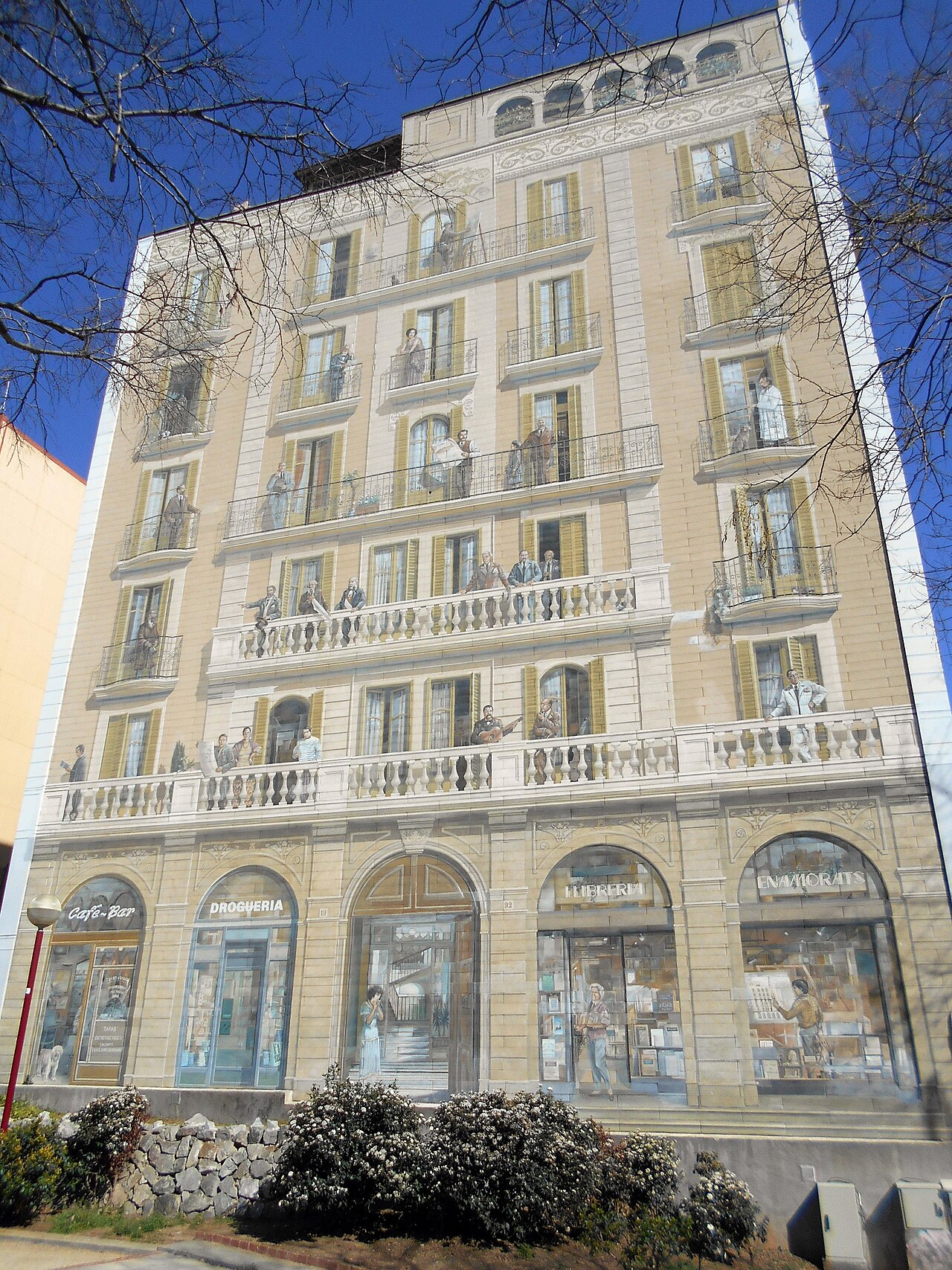
Balcons de Barcelona by CitéCréation, 1992
Spain · wikidata.org
The outfit behind this has apparently done hundreds of painted walls, mostly around France, and the trick is always the same: a blank gable end dressed up as a building that isn't there, with people leaning out of it. They say the figures are usually locals, or names the area is known for.
Erisava: It's a good trick. I'm not sure a good trick is enough.
The Marquesa de Pontejos by Francisco Goya, 1786
National Gallery of Art · wikidata.org
Public domain
Painted around the time she married into the family of Spain's chief minister, from what I can find — the sort of match that was half business, and the portrait was part of announcing it. The clothes are French, which is what you wore in Madrid if you could afford to.
Erisava: Did anyone ever actually look like this, or is it all flattery?
Newspaper and Fruit Dish by Juan Gris, 1916
Yale University Art Gallery · wikidata.org
Public domain
Le Journal was a real Paris daily, apparently the one everybody read — and this crowd of painters stuck it into picture after picture, so often it's practically a signature.
Erisava: The newspaper I get. Somebody talk me through the rest.
Don Manuel Osorio de Zuniga by Francisco Goya, 1787
Metropolitan Museum of Art · wikidata.org
Public domain
The bird has a little card in its beak with the painter's own name on it — supposedly that was his way of signing it. People who've studied it reckon the cats and the caged birds are about how quickly a child's world can turn, though that might be a lot to hang on a family commission.
Erisava: It's meant to be sweet, I think, but those cats put me off it.
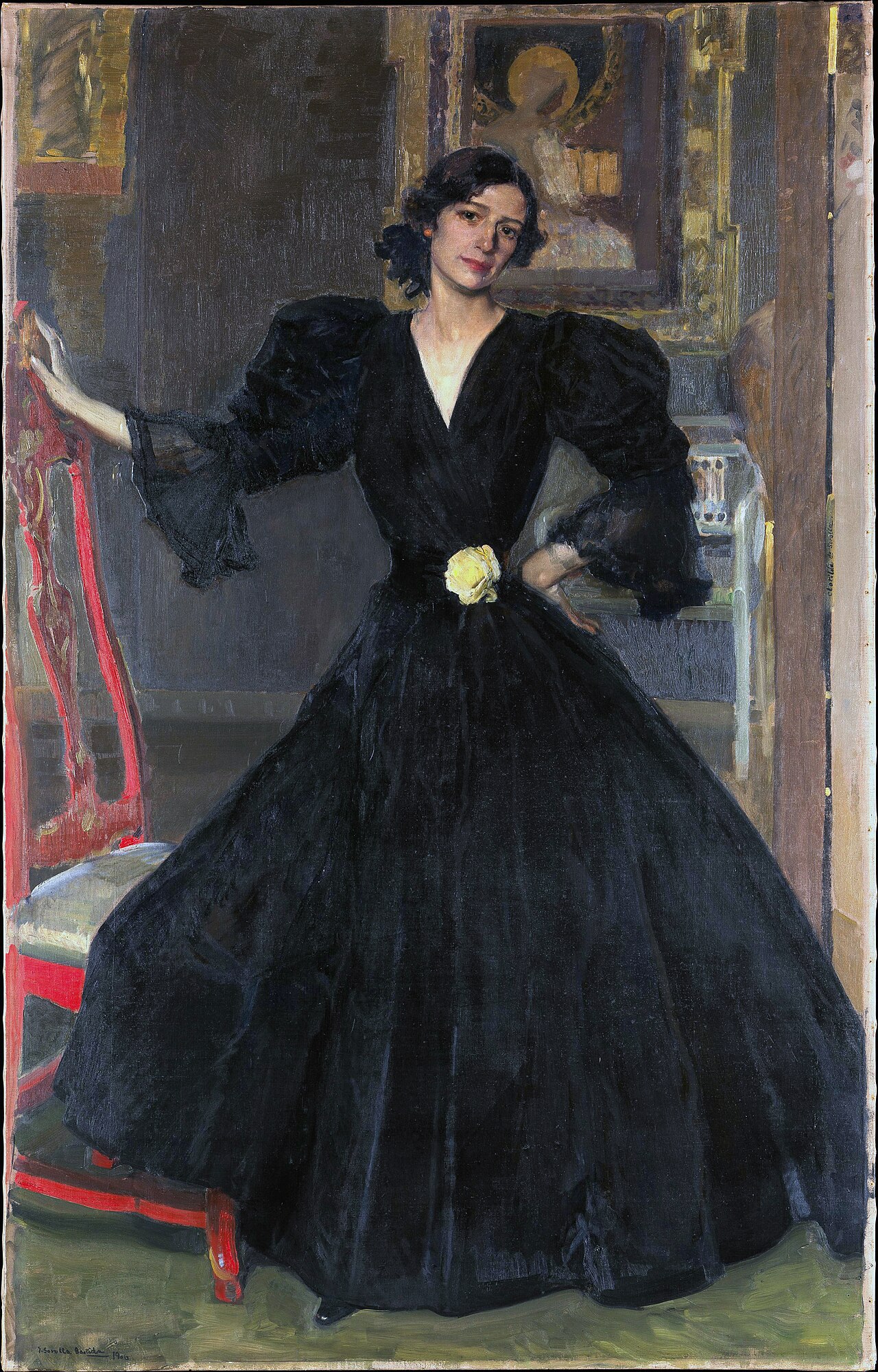
Señora de Sorolla (Clotilde García del Castillo, 1865–1929) in Black by Joaquín Sorolla, 1906
Metropolitan Museum of Art · wikidata.org
Public domain
She apparently sat for him more than anyone else ever did, over decades — from before anyone was buying, right through to when he could name his price. From what I read this one comes from the years he was cleaning up at exhibitions abroad and had queues of people wanting portraits.
Erisava: There's a play between the red chair and the black dress I like.
Portrait of the Jester Calabazas by Diego Velázquez, 1630
Cleveland Museum of Art · wikidata.org
He's holding a paper pinwheel and, apparently, a tiny painted portrait of a woman in his other hand — read by some as a joke about how love never sits still. Calabazas was a real fixture at the court of Philip IV, and the full-length portrait format was usually saved for people a lot further up the ladder than a court jester.
Erisava: He's smiling — you don't see that much in portraits this grand.
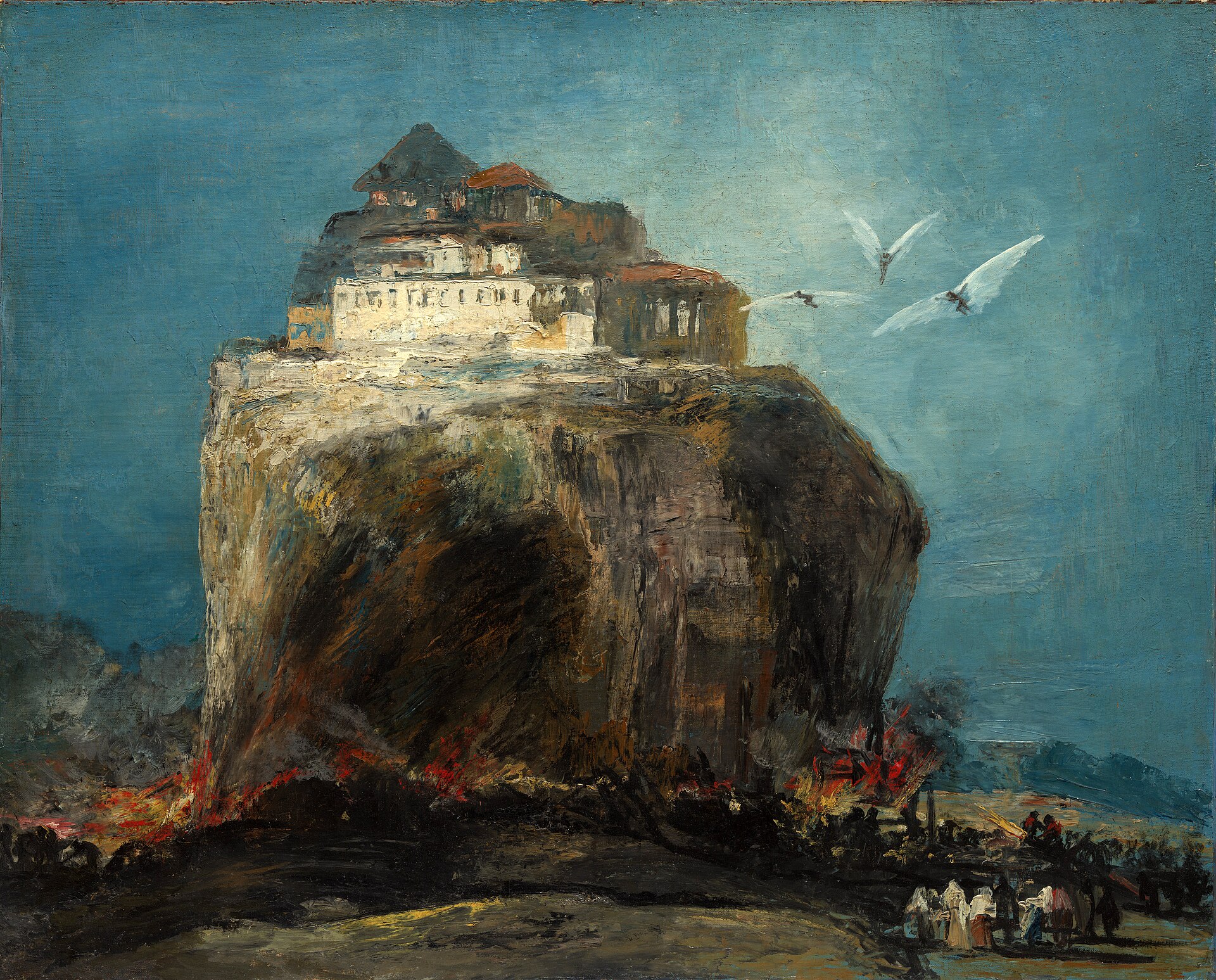
A City on a Rock by Lucas Velázquez, 1900
Metropolitan Museum of Art · wikidata.org
Public domain
This hung as a Goya for years, apparently, before the name underneath got moved to a painter who worked in much the same manner. Same picture, different label.
Erisava: Are those people flying up there, or am I seeing it wrong?
Witches' Sabbath by Francisco Goya, 1820
Museo del Prado · wikidata.org
Public domain
This wasn't made for anyone to see — he painted it straight onto a wall of his own house, in his seventies, deaf and unwell, and it only got peeled off and moved to canvas after he was gone. Nobody seems to agree on what he meant by it, or whether he meant anything at all.
Erisava: It's basically all brown mud — so why is it scaring me?
The Sleep of Reason Produces Monsters by Francisco Goya, 1797
Biblioteca Nacional de España · wikidata.org
Public domain
These were sold as a set of eighty, in an ordinary shop rather than anywhere grand, and pulled off sale after a couple of weeks — the usual explanation is that he got nervous about the Inquisition. This one was meant to open the second half, and there's a note attributed to him saying the idea is that reason and imagination go wrong without each other. Whether that's the whole story, I couldn't tell you.
Erisava: Is this actually frightening to you, or has it just got old?
The Needlewoman by Diego Velázquez, 1635
National Gallery of Art · wikidata.org
Public domain
This one was still in his studio when he died — the inventory afterward just calls it 'another head, of a woman doing needlework.' It's unfinished: the face is fully worked, the rest barely started.
Erisava: Does it feel like she doesn't know she's being watched?
View of Toledo by El Greco, 1596
Metropolitan Museum of Art · wikidata.org
This is, from what I can tell, one of only two landscapes El Greco ever painted — everything else he did was religious work with people in it.
Erisava: What time of day is this supposed to be, with a sky like that?
The Dog by Francisco Goya, 1819
Museo del Prado · wikidata.org
Public domain
These weren't painted on canvas at all — they went straight onto the plaster walls of the house he was living in, and from what I can find nobody thinks they were meant for anyone else to see. They got cut off the walls and stuck onto canvas decades later, which supposedly explains why they look this rubbed-out and battered.
Erisava: There's barely anything here, and I still feel bad for that dog.
Los caprichos: No hay quien nos desate by Francisco Goya
National Gallery of Art · wikidata.org
Most of what I could find reads this one as being about marriage — a knot you couldn't get out of in Spain at the time. It's plate 75 of the same set of eighty. The owl I can't explain, and nobody I read seemed sure either.
Erisava: Whoever looked at this and thought marriage was having a rough time of it.